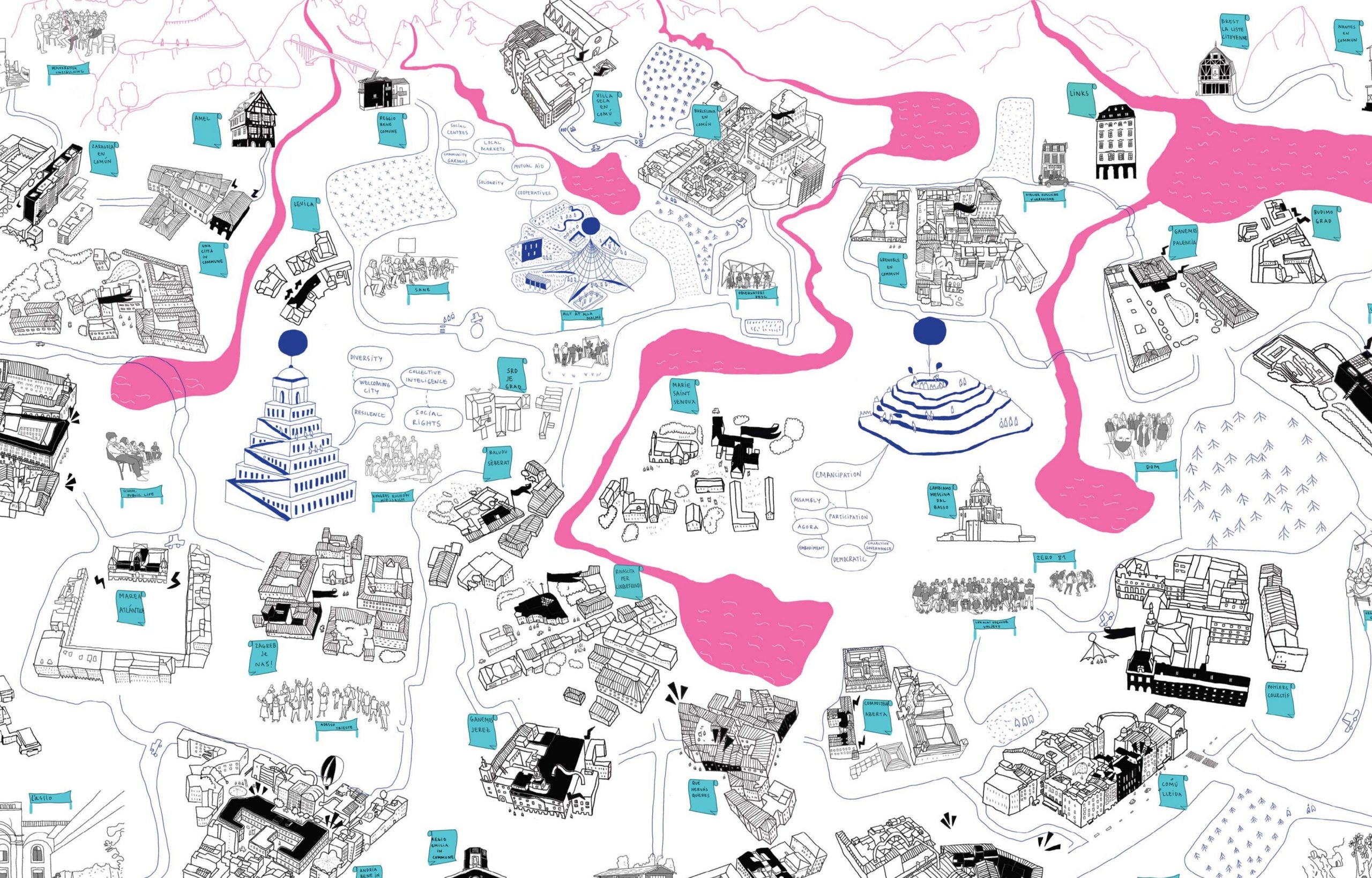
This is part 1 of Research for Action’s blog and podcast series based on Fearless Cities, a summit we co-organised in November 2024. Held in Sheffield and attended by over 400 people, Fearless Cities 2024 explored how local movements are building power in their communities and generating long-term, systemic change towards directly democratic local institutions. This is known as municipalism. Municipalism is about acting locally and looking beyond the nation state as the main theatre for politics. It requires global thinking, co-creating democratic power, inside or in opposition to local democratic structures or by creating autonomous alternatives.
Fearless Cities summits have been at the heart of municipalist movements, held across Europe and the Americas in Barcelona, Warsaw, Brussels, Belgrade, New York, Rosario and Valparaiso. They were initiated by Barcelona En Comú, the political platform that ran that city from 2015 to 2023.
In the closing assembly of the summit in Sheffield, an overarching question was posed; is it possible to change a world facing multiple massive crises by focussing on local action? A year on from the convergence in Sheffield, Gloria Dawson and Steve Rushton explore some answers to this, showing how ‘municipalist’ groups are developing new ways of doing politics, focusing on different uses of cooperatives and cooperation, local approaches to climate breakdown, combating racism and fascism in our cities, building collective and common spaces, re-municipalising public services like transport, and much more.
The first offering is below, with more to come!
Fearless Cities against racism and fascism
By Steve Rushton
Racism pervades every level of recent events. A genocide unfolds on our screens, yet those taking direct action against it are classified as terrorists by the state. War and climate change are pushing people from their homelands, these same people are being demonised by those in the ‘centre’ of the political spectrum as they mimic the far-right and their allies. Business as usual politics doesn’t merely fail to recognise and respond to these dangerous times we live in, it is driving these crises. All the while racism – alongside other prejudices – is catalysed online and on our streets. The far-right thrive by amplifying xenophobic and hateful attitudes that divide people. In its most recent incarnation those demonised include people who are refugees and housed in hotels. As fascism has done before, this diverts attention from the people getting rich off the system. But movements can fight back and out-organise not just these groups, but the rhetoric fuelling their arguments.
Challenging the racism that exists at all levels of society was a central theme of Fearless Cities Sheffield. There were sessions on Anti-racist Cities, which focused on French movement Nous Sommes Montpellier and discussions about the 2024 English Riots; a session entitled How to organise against the far-right and on the opening evening, writer and activist Joshua Virasami launched the book he edited, A World Without Racism: Building Antiracist Futures. The local-based Anti-Raids movement was frequently discussed across the summit sessions and as part of an assembly about intersectional politics and how social movements can combine at the city level with the Kenmure Street action in Glasgow being used as an important reference point
Kenmure Street and beyond
It was early in the morning when the news spread through the streets and online; immigration officers had detained two neighbours in a van in the Pollokshields area on the south side of Glasgow. A local nicknamed ‘Van Man’ attached himself to the vehicle’s axle, while other neighbours blocked its exit and called out for support. Despite more police and immigration officers arriving, local residents and Glaswegians from across the city came in such numbers that the state’s forces could do nothing. The multitude chanted, “These are our neighbours, let them go!” and “Say it loud, say it clear, refugees are welcome here!” By the time their release was negotiated, local people had overcome the security state. The neighbours were freed back into their community.
These localised resistance efforts against immigration raids have been repeated in other cities, including in Edinburgh, Leeds, Manchester and, in London in Dalston and Peckham. Media accounts often report that these are down to spontaneous reactions by local people; in reality, longer-term anti-raids organising has created a local infrastructure enabling less involved locals to take direct action, as researcher Smina Akhtar has explained.
In Glasgow, the No Evictions Network was set up in 2018, connecting movements that had been organising since 2005. The Anti-Raids Network began in London in 2012, with existing movements combining to share resources and expertise, they stressed how anti-raids actions encompass a variety of tactics such as information stalls to educate people on their rights and creating the means for neighbours to mobilise to stop raids. Anti-raids is a movement in its own right, with roots in abolitionism and other anti-racist struggles. Yet its ethos overlaps with municipalism. Both assert that everyone has the right to live in the city, where we are all neighbours and all are welcome. Like municipalism, the anti-raids movement organises in a decentralised manner; both Glasgow’s No-Eviction Network and London’s Anti-RaidsNetworks are confederations of autonomous groups working across their respective cities. These movements build horizontal power against the state’s policies of immigration raids by resisting them through practical means and building solidarity against them.
The hostile environment towards migrants pushed by the government through immigration raids has led to the recent actions across the UK targeting hotels housing refugees. Anti-racism organisations have reacted by organising to show up in solidarity with the migrants. There is also local based organising against Israel’s genocide in Palestine. One example of the latter is Govanhill Apartheid-Free Zone, a local Glasgow campaign that works with local business owners and residents to promote the broader Boycott, Divest and Sanctions (BDS) movement, just a stone’s throw from Kenmure Street.
Racism and other oppressions intersect with each other and are everywhere, and challenging oppression was discussed across the Sheffield summit on issues from housing to environmentalism, reimagining democracy to creating communities of care. The panel discussion on challenging the far-right stressed how challenging racism needs a twin approach, on one hand directly challenging the racism and racist actions, and on the other, organising to end the conditions of impoverishment and isolation – where anger can be channeled against people who are othered. Cooperation Town is a movement of food co-operatives organising in working class neighbourhoods is an example of a project that increases organising capacity while improving members’ material conditions. This project was discussed across the summit, including in the session entitled Challenging the far-right.
Organising Beyond Divide and Rule
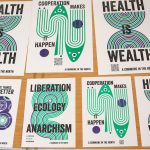
Cooperation Town is a growing network of community food co-ops, set up and run by neighbours for neighbours and is organising on streets and estates across England. It began in 2019 on a London council estate, where residents came together to bulk buy food and top it up with surplus supplies, which would otherwise go to food banks. The Cooperation Town network currently supports over 60 independent food cooperatives of around 20 households each, providing them with resources to organise autonomously, with no central control or top-down decision-making. Each co-op is independent, shaped by its members’ needs, but connected through a shared ethos of mutual aid, self-organisation and working-class solidarity.
More than just about food, Cooperation Town is a political project with a small “p”—fighting exploitation not with slogans, but with everyday action. By helping people to organise where they live—on estates, in church halls, in underused community centres—the network is reclaiming space, rebuilding relationships, and developing the skills and confidence to resist wider injustices. Cooperation Town members are not charity donors or recipients, they are community organisers. In one local food cooperative, neighbours who were not politically active before their involvement with Cooperation Town, went on to organise an eviction resistance for one of the co-op members. In other places, members have started cooking clubs, carried out community research projects and have been on trips together. When a couple of migrant organisers were taken to a detention camp, they built on the skills and connections made working together in a co-op to organise the whole camp and secure its closure.
Cooperation Town offers a means to building community and removing precarity in our communities. Whilst this is vital in itself it also reduces the fear and isolation people can feel which often leads them towards far right populist ‘solutions’.
What was clear from Fearless Cities is how racism and the far-right thrive in a world of crisis. Whilst municipalist actions cannot resolve all these issues alone, thinking of the local level as a key arena to do politics – instead of thinking of politics as solely revolving around the state – is vital to reimagine our world beyond the status-quo.
Fearless Cities also invited participants from the European Municipalist Network to speak and connect with the summit. This included a participant involved in the urban commons of Naples, Italy. In this city six massive buildings are run by weekly assemblies. All the buildings are different, although all the organising done in the buildings is explicitly anti-facist, anti-racist and anti-sexist. These huge buildings include a former children’s prison now called Scugnizzo Liberato (‘liberated street child’). It has been transformed into a self-managed urban commons that offers free cultural, educational, and mutual aid resources, serving as a model of participatory democracy and working-class empowerment.
Another urban commons is called Giardino Liberato (‘Free Garden’). Once a fascist movement occupied this building. In resistance the locals and Neapolitans rose up en masse to peacefully reclaim the space to create another community centre for social activities. The four-story building with a garden now hosts everything from martial arts and meditation to cinema, from free meals and gardening to anti-fascist initiatives.
What was clear from Fearless Cities is how racism and the far-right thrive in a world of crisis. Where the superrich owners of media – including social media – can stoke hatred to divert attention from who profits from this broken system. Whilst municipalist actions cannot resolve all these issues alone, thinking of the local level as a key arena to do politics – instead of thinking of politics as solely revolving around the state – is vital to reimagine our world beyond the status-quo.
Here is a clip from the European Municipalist film Cities Against Authoritarianism, shown during How to organise against the far-right discussion.
Toolkits and how to’s:
Fearless Cities (Barcelona en Comu book)
European Muncipalist Network
How to… set up a local anti-raids group
Home office raids – how to take action
How To Set Up An Anti-Raids Group
Abolitionist Futures resources
European Municipalist Network
Further reading :
A World Without Racism: Building Antiracist Futures Joshua Virasami
We Keep Us Safe: Lessons from Whitechapel’s Defence Hajera Begum
Cooperation Town Ros Ayres
An urban commons in Naples offers a window towards a world beyond prisons Steve Rushton
Collectively resisting facism and building alternatives in Naples Steve Rushton