Three kids on a swing together, smiling and laughing. A lawn and a grand house in the background.

REPORT: Flogged off – Public asset sales at councils getting exceptional financial support

Councils selling off assets to raise money is nothing new, but the current exceptional financial support model is allowing councils to keep their day-to-day spending afloat by borrowing or flogging assets on an unprecedented scale.  Our new report found that more than £1bn of public assets have been sold by councils receiving exceptional financial support (EFS) in the last five years, with targets to flog off another £1bn in 2025/26.  This is happening in the context of a wholesale reorganisation of local government, and a sector-wide financial crisis that has driven many local authorities to the brink of bankruptcy. A... [continues]
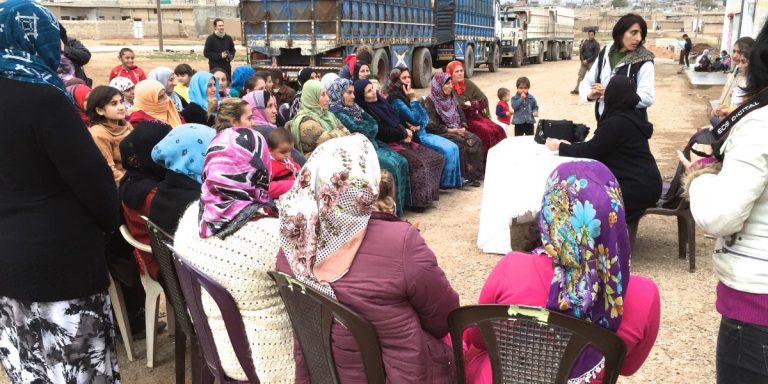
A committee meeting in Qamishlo, Rojava

Fearless cities and neighbourhoods for a living planet: from Sheffield to Rojava

This is Part 3 of Research for Action’s blog and podcast series based on Fearless Cities, a summit we co-organised in November 2024. Held in Sheffield and attended by over 400 people, Fearless Cities 2024 explored how local movements are building power in their communities and generating long-term, systemic change towards directly democratic local institutions. This is known as municipalism.    By Steve Rushton     Note: The Rojava Revolution (featured below) is a women-led multi-ethnic society of millions of people in North and East Syria. At the time of writing it is being invaded and destroyed by the Syrian... [continues]
Fearless Cities: Building our power as a multitude

Fearless Cities: Building our power as a multitude

This is Part 2 of Research for Action’s blog and podcast series based on Fearless Cities, a summit we co-organised in November 2024. The three blogs explore challenging racism, confronting ecological collapse and - in the blog below - sharing power and resources. By Steve Rushton Economic inequality is rampant worldwide, fuelled by decades of neoliberalism that have further elevated the ultra-rich elites to capture mainstream politics and hoard power. This system glorifies individualism and breeds greed. In Britain, it props up class power with its roots in medieval feudalism and its fingerprints all over colonialism. Fearless Cities in Sheffield... [continues]
Photograph of various posters by A Commune in the North, saying things like 'health is wealth', and 'liberation,ecology,anarchism'

Co-operation at the cutting edge – two perspectives

Cooperation seems to be an idea whose time has come for grassroots movements in the UK. Drawing on the Fearless Cities summit session: ‘Building autonomy through a cooperative economy’, we share two interviews with people doing cooperation beyond the traditional worker/housing cooperative form. Cooperation Town and Co-operation Manchester. What does cooperation mean to people right now? What are the relationships between the theory and practice of cooperatives and other tools for organising, like citizens' assemblies and mutual aid groups?   First, we invite you to listen to an interview with Shiri Shalmy, who helped set up Cooperation Town, a movement... [continues]
Fearless Cities against racism and fascism

Fearless Cities against racism and fascism

  This is part 1 of Research for Action’s blog and podcast series based on Fearless Cities, a summit we co-organised in November 2024. Held in Sheffield and attended by over 400 people, Fearless Cities 2024 explored how local movements are building power in their communities and generating long-term, systemic change towards directly democratic local institutions. This is known as municipalism. Municipalism is about acting locally and looking beyond the nation state as the main theatre for politics. It requires global thinking, co-creating democratic power, inside or in opposition to local democratic structures or by creating autonomous alternatives.Fearless Cities summits... [continues]
New report on making councils’ financial information more accessible

New report on making councils’ financial information more accessible

 In new research in collaboration with the University of Sussex, we make a series of urgent recommendations for making council finances less opaque during this time of critical challenge and upheaval in local government.   At a time when scrutiny of council finances is even more important than ever – as authorities declare effective bankruptcy and rely on borrowing and flogging off their assets to balance the books – even experienced researchers, accountants and councillors struggle to find and understand local authority financial information. This is the core finding of a new report by Research for Action and the University of... [continues]
Press release: Local Audit Office plans in devolution bill do not go far enough in fixing crisis

Press release: Local Audit Office plans in devolution bill do not go far enough in fixing crisis

15 July 2025 In a surprise announcement, the English Devolution & Community Empowerment Bill, published last week, outlined the government’s plans for the Local Audit Office. The government had previously promised to fix the local audit crisis and consulted on a range of ways of doing this, but now some of these measures do not feature in the devolution legislation.  The creation of the Local Audit Office (LAO) marks a significant change in the local audit regime. Since the abolition of the Audit Commission in 2015, local authorities have been audited by private companies. This has resulted in declining quality... [continues]
Summer News: governance upheavals, audit reform saga, how you can help our research

Summer News: governance upheavals, audit reform saga, how you can help our research

Dear friends and followers,  Summer is in full swing and there’s lots happening in the world of local democracy. Here are some of the most recent news from Research for Action and friends, and a call for help with our current research…Government wants to abolish the committee system - against the will of Sheffield residents In June, the government announced its intent to ‘simplify’ governance arrangements for local authorities in England, effectively forcing all councils to transition to the leader and cabinet model. It said that the alternative, the committee system, ‘can be unclear, duplicative, and wasteful, leading to slower, less... [continues]
Sheffield democracy campaigners respond to Government intention to overturn their governance referendum

Sheffield democracy campaigners respond to Government intention to overturn their governance referendum

On 24th June, the government announced its intent to ‘simplify’ governance arrangements for local authorities in England. The proposed legislation would force all councils to transition to the leader and cabinet model, stating that the alternative, the committee system, ‘can be unclear, duplicative, and wasteful, leading to slower, less efficient decision-making’.  We at Research for Action have heard from councillors that strong leader models of local governance are more centralised, leading to the marginalisation of backbench councillors and thus are often less democratic. Generally, we have strong reservations about the upcoming English Devolution actually leading to further centralisation of power... [continues]