This is Part 2 of Research for Action’s blog and podcast series based on Fearless Cities, a summit we co-organised in November 2024. The three blogs explore challenging racism, confronting ecological collapse and – in the blog below – sharing power and resources.
By Steve Rushton
Economic inequality is rampant worldwide, fuelled by decades of neoliberalism that have further elevated the ultra-rich elites to capture mainstream politics and hoard power. This system glorifies individualism and breeds greed. In Britain, it props up class power with its roots in medieval feudalism and its fingerprints all over colonialism. Fearless Cities in Sheffield set out how municipalism offers many routes to rethinking power. By sharing power and resources, we can reject the hierarchical classification of bosses and workers, the rulers and the ruled. Instead, people can come together as a multitude to run things collectively. The solidarity economy and participative democracy are two means to break away from a top-down way of creating and recreating the world.
One example of moving in this direction is a group of therapists who are building a decentralised network born from conversations at Fearless Cities and fuelled by a shared desire for change. The therapists got tired of a trade guild that charges £250 a head for its annual conference, and decided to create something different: a peer-led space to share skills, support one another, and break free from a profit-driven model that funnels money upward. They are now The Art Therapy Co-Operative. By putting care for therapists and their patients at the centre of this organisation, they have taken their place in the solidarity economy.
Building the solidarity economy
The Solidarity Economy Association focuses on building networks, offering educational workshops and online resources (links below), coordinating international solidarity efforts, and supporting the creation of new co-operatives. All these actions aim to strengthen the solidarity economy.
A core message at Fearless Cities was that in order to rebuild collective power alongside co-operatives, it is important to protect, reclaim and create community space. This was discussed at length in an assembly about building autonomous power, which heard from participants including from Coalville CAN, a co-op improving Coalville and nearby areas of Leicestershire; The Commune in the North, an anti-capitalist project working from Bentley Urban Farm in South Yorkshire to support community and environment; and Hastings Commons, which transforms unused buildings on England’s south coast into affordable community-run homes, workspaces, and social spaces.
The commons are spaces where everyone has access, and shares responsibility for their management. One beacon of how far the commons can transform a city is Naples in Italy.
Participants from these Neapolitan urban commons explained how six massive buildings are legally recognised as spaces of mutual aid and other many other social and political activities. These are all run by weekly democratic assemblies,with the only stipulation being that everyone agrees the space is anti-sexist, anti-racist and anti-fascist.
This short clip shows part of the European Municipalist Network documentary shown at Fearless Cities:
Democratic assemblies and platforms
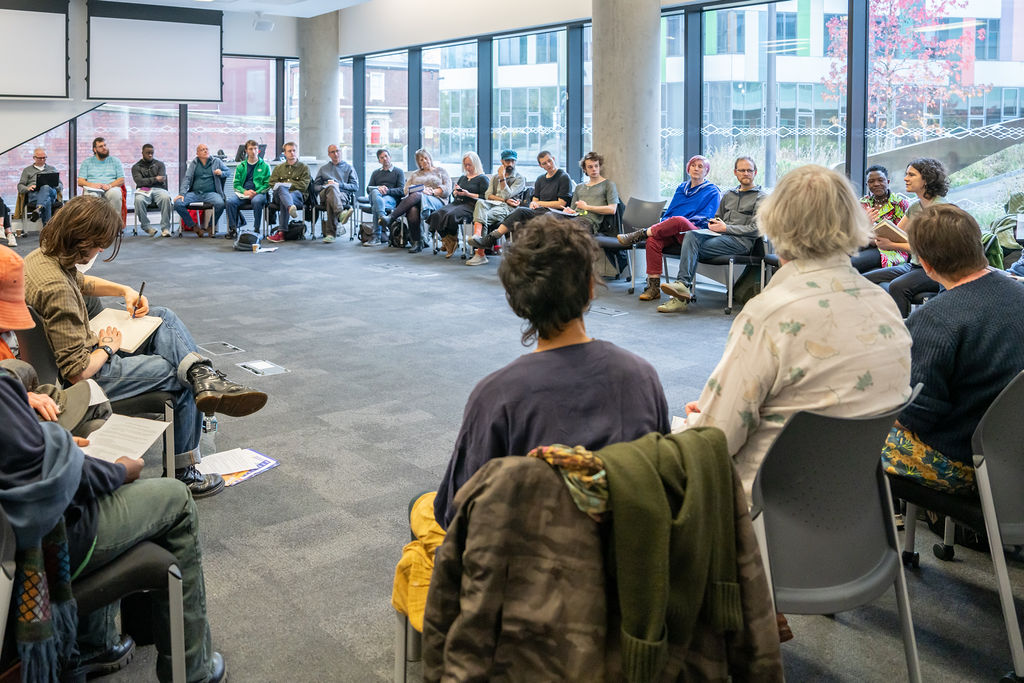
Three assemblies were organised within the Fearless Cities summit. Assemblies involve participants spread out in the largest circle that the room will allow. Circles are important to make sure everyone can make eye contact and has an equal opportunity to contribute. The aim of the Fearless Cities assemblies was to offer the platform to everyone to speak about their experiences running municipalist or other horizontal projects. This contrasts with the more top-down approach of a few speakers that most people are used to.
In regular, repeated assemblies participants co-create their shared culture of consensus and cooperation, and develop a shared action. Compared to the standard top-down approach of most summits or conferences, the three assemblies at Fearless Cities were an opportunity to to platform more voices. A little chaotic at times, this approach nevertheless succeeded in creating a space where many people could explain about democratic projects they were involved in, or had the chance to ask questions that generated further discussions and knowledge sharing.
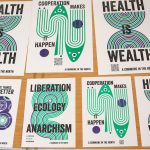
Participants from Cooperation Hull were prominent throughout the assemblies and the wider summit. They are establishing neighbourhood assemblies across Hull, aiming to make it the first UK city organised through a confederated assembly system. In this structure, all neighbourhoods send delegates to a city-wide assembly. Cooperation Hull also runs teach-ins and open educational events, celebrates art and music, and brings people together through communal cooking and shared meals. One key outcome of the Fearless Cities summit was renewed momentum for local assemblies—Sheffield included. With support from Cooperation Hull, Cooperation Sheffield is now hosting its own neighbourhood assemblies.
Everyone in the assembly circle is encouraged to challenge entrenched power dynamics and hierarchies. This was the focus of a workshop titled The Feministisation of Politics. In a packed session, participants dared to imagine a world free from patriarchy and hierarchical power. Working in small groups, they envisioned futures beyond oppression, then used ‘backcasting’ to identify the steps needed to reach them. Backcasting reverses traditional planning: you start with the future you want and work backwards to map the path. What followed was a powerful exchange of radical visions and the concrete actions required to make them happen.
This workshop marked the first collaboration between Feministisation of Politics (FoP) and Feminise Politics Now! (FPN!). It opened with each group sharing their origin stories and visions. While their journeys differ, both are at the forefront of the call to femin(ist)ise politics—an approach interwoven with municipalism. The Feministisation of Politics is about making sure our movements do not replicate oppressive structures rife in society by, for example, ensuring gender parity in all political spaces, reducing hierarchy to prioritise collective intelligence, promoting shared responsibility between all genders in both activism and personal life, and making gender equity the guiding principle of all political action. FoP is a Europe-wide alliance of non-male activists in municipalist and aligned movements which was founded in 2018. FPN! emerged in 2020 across Britain, bringing together voices from diverse social movements.
Front and centre within municipalism, the Feministisation of Politics movements inspired the creation of the European Municipalist Network. Before the summit, this network held an open meeting in a solidarity kitchen in Sheffield, which gave the chance for UK municipalists to reconnect and connect with the network and to scheme together. Participants from EMN also organised and contributed to many of the weekend’s sessions.
Another session using ‘backcasting’ showcased another democratic method developed by EMN participants. The Italian movement Adesso Trieste took participants on a walking tour around Sheffield. Led by Giulia Massolino, Regional Councilor from the movement, participants imagined a utopian city of the future and collectively imagined and discussed what they needed to do to get there from now.
Adesso Trieste is a municipalist party in opposition in Trieste, northeast Italy, with 3 city councillors, 14 neighbourhood council seats and Giulia Massolino sitting at the regional council of Friuli Venezia Giulia. One of their projects is challenging gentrification in the area of Maddalena. Through a committee called Maddalena Vive (Maddalena is Alive) the project will create a participatory design process. Through this, locals are collectively creating an alternative plan for the whole community’s benefit; not only for property speculators. This is another way to redistribute power locally.
Platform municipalists are formed when social movements combine to run for city elections. This approach was extremely successful in Spain’s 2015 municipal elections, when many major cities and towns were taken over by movements with “one foot in the streets and one in the institutions.”
Barcelona became the global heart of municipalism when this new platform, Barcelona En Comú, led the city council from 2015 to 2023. Created from social movements, this group crowdsourced their manifesto, held neighbourhood assemblies to guide decisions, and filled the City Hall with activists instead of career politicians. Their eight-year run transformed the city: launching Barcelona Energia, Spain’s largest public renewable energy company, reclaiming streets from cars through Superblocks, cycle lanes, and greener public transport; and creating an anti-eviction unit, co-operative housing support, and a low-cost municipal dental service—despite fierce pushback from private lobbies. They also put the feminisation of politics on the global agenda, redefining power around care, equality, and collaboration, and led the Refugees Welcome movement which aimed to make Barcelona a city of solidarity and sanctuary.
One theme that came up a great deal at Fearless Cities in Sheffield was how many platform municipalist movements in Europe have the advantage of less dysfunctional voting systems compared to Britain’s first-past-the-post system. This means the threshold for winning the city, or seats in City Hall, is lower at city and municipal elections. One UK city-based platform movement who joined Fearless Cities is People’s Plan for Glasgow. Another UK based version of this is known as Flatpack Democracy, wherein rural areas and small towns particularly in the West of England, citizens have built a platform to take back their towns and villages.
Other examples of platform municipalism across Europe include those in the Balkan countries, where Zagreb is a major city controlled by a left-green municipalist movement called Možemo! (We Can). Another example is Catalonia’s Popular Unity Candidacy (CUP), a pro independence, anti-capitalist, assembly-based movement rooted in municipalism. Both CUP and Barcelona en Comú compete in the city elections, demonstrating how municipalism is not a ‘one size fits all’ model, but a collective expression of its participants. Just as Barcelona en Comú have remunicipalised energy provision in the Catalan capital, CUP have been part of a remunicipalisation drive across Catalonia, including the water services in Teressa. Stay tuned for more: remunicipalisation features more in the next blog in the series: Cities and Neighbourhoods for a living planet.
Tools and further reading
Fearless Cities by Barcelona en Comú
Lots of resources from Solidarity Economy Association
The solidarity economy: a visual guide
Feminise Politics Now! booklet
Toolkit for groups to Feministise politics
Cooperation Jackson – Building a solidarity economy in Jackson, Mississippi, US anchored by a network of cooperatives and worker-owned, democratically self-managed enterprises.
Held in Sheffield and attended by over 400 people, Fearless Cities 2024 explored how local movements are building power in their communities and generating long-term, systemic change towards directly democratic local institutions. This is known as municipalism. Municipalism is about acting locally and looking beyond the nation state as the main theatre for politics. It requires global thinking, co-creating democratic power, inside or in opposition to local democratic structures or by creating autonomous alternatives. Fearless Cities summits have been at the heart of municipalist movements, held across Europe and the Americas in Barcelona, Warsaw, Brussels, Belgrade, New York, Rosario and Valparaiso. They were initiated by Barcelona En Comú, the political platform that ran that city from 2015 to 2023.
The summit had too many movements to mention, likewise there are so many movements out there. Here are some toolkits and inspiration. Thanks to all our friends across the movements for their suggestions.
Tips and tools for running a democratic local assembly
The solidarity economy a visual guide
Cooperation Town starter pack
Massive Open Online Course on the topic of Feminisation of Politics
FoP Handbook
Toolkit for groups to Feministise politics
Community-led, power-with assemblies handbook
Take the Jump: Ambassador Training
HOW TO GUIDE – WAFFLE Start your own Pay What You Can pop-up restaurant
Starting a Food Coop or Savings Club
Elections belong to everyone – guide to grassroots electoral campaigns (guide in Hungarian by School of Public Life/Közélet Iskolája in Budapest)
https://www.italiaimpossibile.it/risorse/
Resources in Hungarian about municipalism, grassroots politics and grassroots campaigning
Hungary: From housing justice to municipal opposition