By Steve Rushton
Capitalism is destroying the planet’s habitability. We live in a world that prioritizes profits over everything else and is destroying the atmosphere, polluting our water, degrading the soil, and the other vital resources we depend on. The state-based political system is co-opted by corporate interests that push either the false promises of green capitalism or a retreat from any meaningful climate and ecological changes needed. This is demonstrated by the 30 annual international COP climate summits which have failed to reduce the levels of CO2 emissions. Against this dire situation, a key question discussed at the Fearless Cities summit in late 2024 is how we can address these urgent issues by organizing at the local level. Instead of relying on a state-centric system captured by corporations intent on speeding up consumption and extraction, there are alternatives emerging locally that challenge ecological destruction and co-create ways of living in balance with the planet.
When the municipalist movement Barcelona en Comú ran the Catalan capital, they created the public energy company Barcelona Energia. The company founded by the municipalist city government led by Barcelona en Comú aims to supply 100% renewable energy to Barcelona, and was set up in early 2018. This is known as (re)municipalisation, where utility companies are taken out of private hands and managed at the local level, rather than nationalisation by the nation-state.
Community-owned power and production
Remunicipalisation was a hot topic at Fearless Cities. It allows utility companies to be at the forefront of ecological shifts as an alternative to corporations. Unlike companies which care only about one thing—profit—publicly-owned utility bodies instead can prioritize what really matters: shifting from fossil fuels to renewable energy and serving the community first with affordable prices. Since the start of this millenium, there have been over 1400 examples of remunicipalisation across the world, according to the Transnational Institute (TNI).
Paris now has a municipally-owned water company, and Berlin has a similar setup for energy: two examples of this surge in remunicipalisation. At the summit remunicipalisation was discussed as a solution to the devastating privatisation programmes started by Thatcher, and a democratic alternative to monopolised state control.
The cooperative model has evolved from the Industrial Revolution as an alternative to industry and capitalist corporations that generate profit for the few while impoverishing workers. Coops and cooperation are leading forces within the municipalist movement (as the previous blog discussed). During the summit in Sheffield, energy cooperatives were discussed as another means of changing our energy system to make it both more ecological and more socially equable.
Brixton Energy in south London is an example of this in the UK. They have installed solar panels on council housing in three sites. At the other end of the isles, across the Highlands and Islands of Scotland communities have bought back their islands and set up renewable energy, including wind, solar and tidal power. The communities use this energy for their needs and sell surplus power back via the National Grid, using the money for a range of different means, including retro-fitting houses, community food growing polytunnels and other projects to revitalise their communities and reverse population declines – a big problem for islands and rural communities.
Transport is a key sector driving the ecological crisis, whether from carbon emissions or resource extraction. This is especially true for electric vehicles. One core municipalist demand is making an affordable and highly functioning mass transport system to reduce our reliance on private vehicles. Get Glasgow Moving is one movement at the forefront of this struggle. Ellie Harrison from the movement explained how there is a silent revolution going on across these isles, with privatised bus services being brought back under public control in cities including Manchester, Liverpool and Glasgow. Rethinking how we grow food and reclaiming unused buildings are two other municipalist pathways for shifting away from profit-driven capitalism towards an ecologically sound alternative.
Fearless Cities also showcased community good growing, and using vacant plots of land for community projects. The supermarket-controlled food system wastes many tonnes of food every year and impoverishes the farmers growing the food, in this country and beyond. Across Europe an estimated one in six of buildings lie empty, a horrendous social and ecological situation. By taking control of buildings that are going to waste and by producing our own food at the local level, we can efficiently use and share resources and stop them lying idle.
Ending ecological destruction and degrowth
Naples Urban Commons show us how far repurposing unused buildings can go. Two urban commons in the northern district of Bagnoli showcase how a working class neighbourhood can demand the recovery of a district that is now an industrial sacrifice zone (see previous two blogs for more). Bagnoli was once home to one of Italy’s largest steelworks. Closing down in 1992, it left a toxic legacy, which means the beaches and many parts of the district are dangerously polluted no-go areas. After the steelworks closed, the state (who owned the steelworks) promised to clean up and revive Bagnoli. Yet little happened. Some projects worsened the damage and wasted public money. Two of the urban commons in Bagnoli, Villa Medusa and Lido Pola host many social, political and mutual aid events including the Popular Observatory of Bagnoli. This body has parallels with a citizens’ debt audit, although instead of neighbours and the multitude building a body to investigate odious debts, it is a movement of people challenging the destruction of nature. The Popular Observatory meets regularly, turning gatherings into social events that mobilise residents and spread information across Bagnoli. It holds press conferences, raises public awareness, and keeps pressure on the city and authorities to deliver on their promises of a clean, healthy, and truly decontaminated Bagnoli.
On a global scale, the climate commitments made at the 2015 Paris Climate Conference, which themselves were very modest, are not being respected. The term ‘fossil fuels’ was not even written into the final main agreement at Brazil’s Belem climate summit COP30. Against this backdrop cities and regions are leading a fightback. Lucas Snaije from the Fossil Fuel Non Proliferation Treaty explained how cities across the world have joined a coalition of countries in the majority world threatened by a crisis not of their making. London, Birmingham and Glasgow have joined many more towns and cities across the UK and worldwide to sign up to the Fossil Fuel Non Proliferation Treaty and pledge to do their part to reduce carbon emissions to mitigate some of the global heating. This initiative, initiated by nation-states at the frontline of the climate pressure, shows how cities can fill the gap when powerful nations fail to take action. The United Nations estimates that 70 per cent of emissions are made in cities, which means they are a space to drive change, even when nation-states are co-opted by corporate interests.
Cities are also epicentres of mass consumption. One movement challenging this which featured at the summit is challenging advertising. Corporate advertising is bad for cities because it allows big companies to dominate public spaces, shaping urban life around consumerism rather than community needs and democratic control. It also deepens social inequality by concentrating advertising in more deprived areas and promoting harmful stereotypes, such as unattainable beauty standards. Environmentally, corporate advertising encourages high-carbon products (e.g. SUVs) and overconsumption, while energy-intensive digital billboards contribute directly to ecological damage and greenwashing. In a panel discussion about Degrowth and Rights to the City, Robbie Gillet from Adfree Cities outlined the growing network of decentralised Adblock movements across the UK. This movement has parallels with the municipalist movement, not least in arguing that we should have a ‘right to the city’. This means that we should collectively decide how our cities are run, including getting corporations out of our urban spaces and our imaginations.
Anti-advertising, cities ending our dependency on carbon and making public transport work for everyone were front and centre in a panel discussion about Degrowth and Rights to the City. This was also heard from participants from Degrowth London. Across the world there is a great deal of energy for Degrowth approaches, which reject the dogma that pervades our lives that the economy needs to grow. Simply argued, you cannot have infinite growth on a finite planet. As the session made clear, there are no healthy places on a dead planet. Likewise, to challenge the state-corporate centric growth model we need to rethink power beyond the state.
Here’s a snippet from the European Municipalist Network documentary shown at Fearless Cities:
https://youtu.be/H3a2WKJCB2s
Fearless Cities beyond Fascism, Inequality and Climate Breakdown
An evergreen question for municipalists, or any movement looking to build alternatives to the corporate-state dominated world is about scale. How can we scale these approaches up? This question is vital – whether we are asking how we can move beyond the ecological crisis, tackle economic inequality or deal with structural oppressions such as racism.
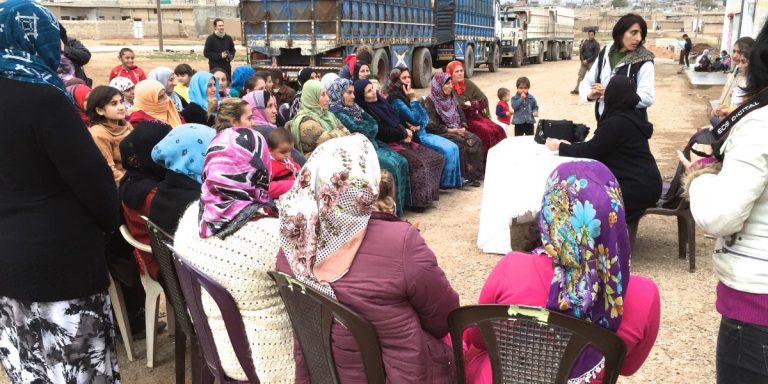
Rojava, the democratic women-led autonomous area of Northern Syria, was one example often discussed widely across the summit. Rojava is an autonomous region of millions of people, which in its scale shows how another world beyond capitalism and hierarchy is possible. Its politics is based on democratic confederalism – this means it organises with the local neighbourhood assembly as important as the sub-regional and regional administration. Participants from the local assemblies – a man and a woman – go on a rotational basis so the autonomous region can organise. Yet power remains at the local level. The autonomous region is the subject of much writing; one place to start is through the Solidarity Economy Association, which works in projects alongside Rojava.
Rojava and democratic confederalism were instigated by the Kurdish liberation struggles, yet today it is a mosaic of different ethnicities collaborating together. One example of how this society challenges racism and relates to refugees and migrants is that its collectively written constitution makes refugees welcome. To overcome structural power and hierarchy, Rojava is an explicitly women-led revolution, from women’s fighters beating ISIS to ‘women’s houses’ in every town. Economically, this society is also rebuilding based on cooperatives.
Rojava is an autonomous region in the middle of a war zone, with hostile forces on all sides. Despite this, the revolution is also moving towards an ecologically improved future. One example of this is the old massive farms of Northern Syria are offered to women’s cooperatives. Against a drought induced by climate meltdown and Turkey’s violent water policies, these cooperatives are building wells and shifting food production away from water intensive agriculture, grown for export and profit, instead growing food to eat and growing trees to re-irrigate the land. The Solidarity Economy Association supports the Water for Rojava project; more details can be found here.
Fearless Cities in Sheffield offered the chance to celebrate oases of anti-capitalism, whether they involve millions of people like Rojava, or whether they are a handful of houses on a working-class street. Municipalism offers many different routes to think and act outside the unjust, profit-driven and hierarchical system. By taking one of the many steps on this journey together, we can reimagine another future.
The summit had too many movements to mention, likewise there are so many movements out there. Here are some toolkits and inspiration. Thanks to all our friends across the movements for their suggestions.
Brandalism manual – how to subvertise to corporate ad space
How to ban fossil fuel advertising at a municipal level
10 Step Guide to Setting Up a Community Energy Group
Living Well on a Finite Planet: Building a Caring World Beyond Growth